
Nanjing Elephant-Med instrument Co. , Ltd.
MOBILE:
ADDR:86 Shuanggao Road, Economic Development Zone, Gaochun District, Nanjing City
WEBSITE:http://www.elephant-med.com/




ligasure, bipolar, surgical electrode, high frequency surgical system
POSITION: HOME > EN > Product articles
ABOUTUS
PRODUCTS
roduct categoryCONTACT
ontact usNanjing Elephant-Med instrument Co. , Ltd.
MOBILE:
ADDR:86 Shuanggao Road, Economic Development Zone, Gaochun District, Nanjing City
WEBSITE:http://www.elephant-med.com/
What is an energy device
Energy surgery refers to the branch of surgery in which surgeons use various energy devices to cut, separate, stop bleeding and achieve various other functions of tissues during surgery.
Energy devices refer to the instruments used in the above-mentioned surgical process to emit energy, such as high frequency, ultrasound, microwave, etc., which interact with living tissues and cut tissues and organs to stop bleeding.
With the gradual refinement of surgical specialties, the categories of energy surgery equipment suitable for various surgical specialties are becoming more and more abundant. In response to the different needs of surgeons in different surgeries, there are specially designed energy surgical devices to respond to almost all situations. At present, more and more forms of energy such as radiofrequency, ultrasound, plasma, and laser are being widely used in minimally invasive surgery.
From the perspective of energy utilization, it can be divided into two categories: electrical energy and mechanical energy.
Utilization of electrical energy: The principle of action is to generate the voltage and current of the corresponding frequency through the generator, which is conducted to the acting electrode, and the acting electrode generates the corresponding temperature on the tissue, so as to achieve the desired effect (solidification or cut-off), and then the current is returned through the grounding electrode. Such as single-stage electric knife, bipolar electric equipment, radiofrequency ablation equipment, argon knife, etc.
Use of mechanical energy: The most commonly used is the ultrasonic knife, which generates heat energy when it comes into contact with the tissue through the high-frequency vibration generated by the cutter head, so as to achieve functions such as coagulation or cutting. Siyu summarizes the energy devices according to four types: electrical energy devices, cryosurgery, laser surgery, and microwave surgery.
Principles of energy devices
How to deal with intraoperative bleeding? It has always been one of the most frustrating problems faced by surgeons.
Nearly 100 years ago, in most cases, surgeons used the heat generated by the cautery method to stop bleeding from surgical wounds. Today, heat is still at the heart of energy surgery, with the only difference being that with advances in technology, surgeons are able to control heat better.
What does heat do to the human body?
At 60 degrees: the protein begins to irreversibly denature and coagulates necrosis, and the tissue often appears whitish at this time.
At 80 degrees: the tissue is carbonized, resulting in dryness, dehydration and atrophy
90 degrees to 100 degrees: The cells "volatilize", and the surgeon often only sees a wisp of green smoke drifting by.
Above 125 degrees: The proteins and fats in the tissues are completely oxidized, leaving only carbonized tissues (eschar).
Then the above-mentioned tissue reaction also determines the function of the energy device at different powers:
At temperatures between 60 and 80 degrees, protein denaturation (coagulative necrosis) is mainly produced, which plays the role of coagulation of various channels (hemostasis), and at temperatures above 90 degrees, it plays the role of cutting tissues.
Electrical energy devices
"The development of the first commercial electrosurgical device was developed by William T. Bovie, who developed the first electrosurgical device while at Harvard University. Between 1914 and 1927, Bovie discovered that high-frequency alternating currents in the range of 250,000-2,000,000 Hz could be used to cut open coagulated tissue and obtain hemostasis. On October 1, 1926, the first use of electrosurgical equipment in surgery was made at Peter Bent Brigham Hospital in Boston, Massachusetts. Harvey Cushing (1869–1939) popularized the device in neurosurgery; He first used it in the operating room in 1926 and has used it in more than 500 neurosurgical operations. ”
Electrocautery:
It is a process that destroys or cuts soft tissues by heat conduction of a metal probe heated by an electric current. This method uses an electric current to heat the wire, which is then applied to the target tissue for combustion or coagulation. The current does not pass through the tissue, but is applied directly to the target area of the treatment. This pattern is commonly applied to superficial lesions encountered by dermatologists, ophthalmologists, plastic surgeons, urologists, and related specialties.
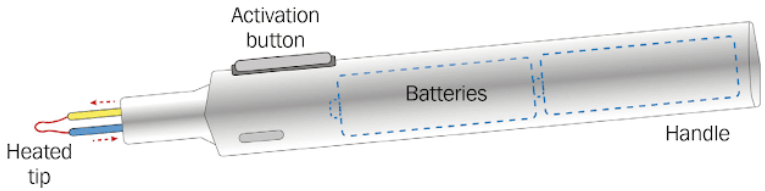
▲Diagram of the electrocautery forceps pattern (source:www.cehjournal.org)
Electrosurgery:
Unlike electrocautery, electrosurgery is the application of high-frequency (radiofrequency) alternating polarity (AC) currents to biological tissues as a means of cutting, coagulating, drying, or electrocauterizing tissue. Its benefits include the ability to make precise cuts in limited cases of blood loss.
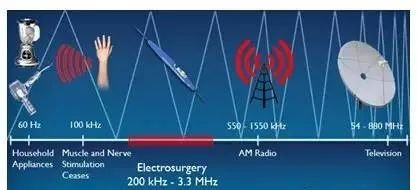
The electricity used in electrosurgery is a type of alternating current, similar to the alternating current used to generate radio waves. The frequency is quite high, with the standard being around 500,000 cycles per second. This ensures that the current passes through the patient's tissue rather than creating an electric shock effect. Heat is generated by the resistance of the tissue to the electric current. The tools used to apply the current are electrodes, which can be in the form of blades, balls, needles, and ring configurations. These devices can be used to cut, coagulate, and even fuse tissue.
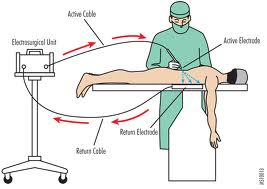
▲Diagram of the pattern of single-stage electrosurgery (source:www.iambiomed.com)
The generator used in radiofrequency electrosurgery is called the electrosurgical unit or ESU) The electrodes are handheld and consist of one (monopolar) or two electrodes – bipolar instruments, also known as unistage/bipolar electrical devices.
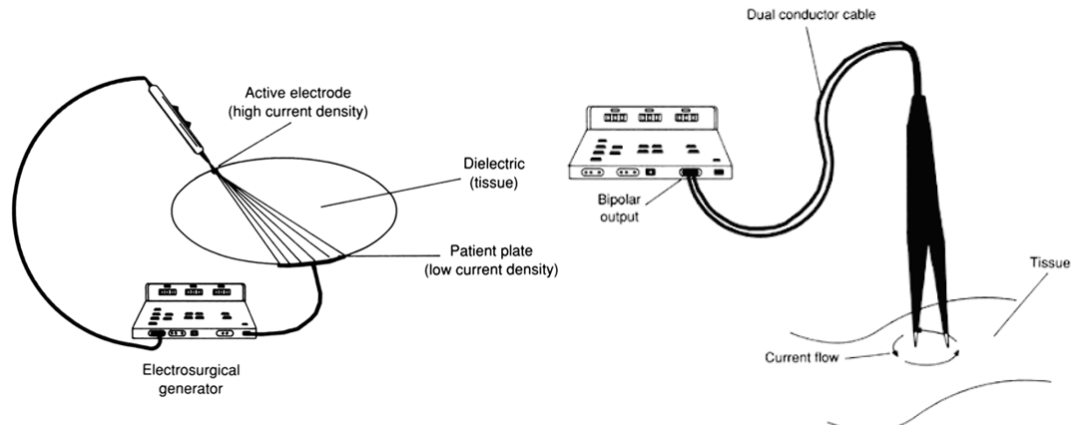
▲(Left) Monopolar electrical equipment; (Right) Bipolar electrical device (Source:resources.ama.uk.com)
Electrosurgical instruments have been widely used in various fields of surgery, from the most basic surgical incisions, visceral tissue block resection, incision hemostasis, to tumor ablation and other applications; From general surgery, cardiothoracic surgery, to gynecology, urology, otolaryngology, orthopedics, neurosurgery and other departments; From open surgery, to minimally invasive surgery and even medical treatments. High-frequency electrosurgery can be seen in operating rooms, emergency rooms, outpatient rooms, and endoscopy rooms.
1. Single-stage electric knife:
All electrosurgical procedures are "bipolar" because an electric current flows from one pole or electrode to another. In monopolar electrosurgery, the active electrode is one electrode, while the patient-return electrode is another. The main difference between monopolar electrosurgery and other energy modalities is that an electric current flows through the patient. This difference maximizes the range of tissue effects of monopolar electrosurgery, and when the temperature of the electrode is generated, the current is returned to the generator through the grounding electrode (negative plate).
In a monopolar instrument, the surgeon touches the tissue with a single small electrode. The exit point of the circuit – the dispersed electrode is a large surface area, such as the buttocks, to prevent electrical burns. The function of the large surface area described above is to disperse the RF current, thus preventing thermal damage to the underlying tissues. The amount of heat generated depends on the size of the contact area, the power setting or current frequency, the duration of the application, and the waveform. A constant waveform generates more heat than an intermittent waveform. It is used to cut tissue more frequently than in coagulation mode.
2. Bipolar Electrical Equipment:
In the bipolar system, the acting electrode and the grounding electrode are both on the handheld device, and the current does not pass through the body, maximizing the utility of the electrosurgical equipment, which has the advantage of better electrocoagulation effect, and can condense larger diameter (7mm) pipes when used correctly. There are a wide variety of bipolar devices on the market today, including Covidien's LigaSure, Ethicon's ENSEAL, and ERBE's Bioclamp, among others.
In a bipolar instrument, an electric current is passed between the two tips of a forceps-like tool. It has the advantage of not interfering with other electrical activities, such as the conduction system of the heart, and also coagulates tissues by pressure. Lateral thermal damage is less than that of unipolar devices.
3. Radiofrequency Ablation Equipment:
The basic principle is the same as that of a single-stage electrosurgical unit, but the device can adjust the output current by monitoring the impedance, and ensure that the temperature generated by the acting electrode is constant (not changing with the change of impedance) for a long period of time (5-10 minutes). Radio frequency (RF) alternating current heats tissues by inducing intracellular oscillations of ionized molecules, resulting in an increase in intracellular temperature. When the intracellular temperature reaches 60°C, the cell dies instantaneously. If the tissue is heated to 60-99 °C, the process of tissue drying and protein coagulation occurs simultaneously.
If the intracellular temperature reaches 100 degrees Celsius rapidly, the conversion of the intracellular substance into a gas occurs, vaporization. While the process is technically electrocoagulation, the vaporization process can be used to ablate tissue targets or, by linear extension, to transversely cut or cut tissue. The processes of vaporization/cutting and drying/condensation are best done with relatively low voltage, continuous or near-continuous waveforms.
Radiofrequency electrosurgery is commonly used in almost all surgical disciplines, including dermatology, gynecology, cardiac, orthopedics, ophthalmology, spine, otolaryngology, maxillofacial surgery, orthopedics, urology, neurosurgery, and general surgical procedures, as well as certain dental procedures.
4. Wet-field electrosurgery:
Wet-field devices are operated in saline solutions or in open wounds. Heating is generated by alternating current between the two electrodes. Heating is usually greatest where the current density is highest. As a result, it is usually the smallest or sharpest electrode that generates the most heat.
Most wet-field electrosurgical systems operate in two modes: cutting and coagulation. "Cutting" causes a small piece of tissue to evaporate, while "coagulation" causes the tissue to "dry" (in the sense of hemostasis). "Dry" tissues are dead tissues that subsequently fall off or are replaced by fibrotic tissue, but they are temporarily physically intact after electrosurgical application. The depth of tissue death is usually a few millimeters near electrode contact.
5. Argon Knife:
Argon can enhance the energy output of electrical equipment (this gas should also be used in welding) and is often used in surgery to stop bleeding in solid organs (such as the liver).
This article is uploaded and authorized to be published by the user of "Health Account", and the above content (including text, pictures, and videos) does not represent the position of the health community. "Health Account" is an information publishing platform, only providing information storage services, if there is any reprinting, infringement and other questions, please contact the health community (jkh@hmkx.cn) for processing.
WEB SITE:http://www.elephant-med.com/
TEL:025-57852662
WeChat:ailifen0002 EMAIL:support@elephant-med.com
Nanjing Elephant-Med instrument Co. , Ltd. 86 Shuanggao Road, Economic Development Zone, Gaochun District, Nanjing City ICP No.:苏ICP备2025153396号-1  苏公网安备32011802010375号 互联网药品信息服务资格证书编号:(苏)-非经营性-2024-0128