



Nanjing Elephant-Med instrument Co. , Ltd.
MOBILE:
ADDR:86 Shuanggao Road, Economic Development Zone, Gaochun District, Nanjing City
WEBSITE:http://www.elephant-med.com/
ABOUTUS
PRODUCTS
roduct categoryCONTACT
ontact usThe generation of energy instruments is the inevitable result of technological development, which can improve the efficiency of surgery and reduce intraoperative bleeding, and change the previous transabdominal surgery to translaparoscopic or robotic surgery, but once you don't know the principle and human anatomy, the indiscriminate use of energy instruments will lead to irreversible disasters, which are much more serious than the damage caused by non-energy instruments. Let's start with a brief analysis and description of the common energy instruments available today.
Knife
1. Detachable scalpel
The scalpel is the basic surgical tool in surgery, and most scalpels nowadays are removable, consisting of a handle and a blade. The handles are usually #3, #4, and #7, which in turn become longer to accommodate different shades of operation. #3 handles are mainly used for delicate operations such as ophthalmology and hand surgery, while #4 and #7 handles tend to be more commonly used in major surgical procedures.
For residents, the relevant operation would be skinning, which is often done with a No. 4 handle and a No. 20 blade, a combination often referred to as a skinning knife.
This combination is often referred to as a dermatome. The tip of the dermatome is usually used to pierce the skin and then the belly of the dermatome is used to cut through the skin. It is important that the dermatome be perpendicular to the site of the cut, as otherwise there will be asymmetry of the subcutaneous tissues bilaterally, which can cause problems with postoperative closure, and is particularly important in thyroid surgery.
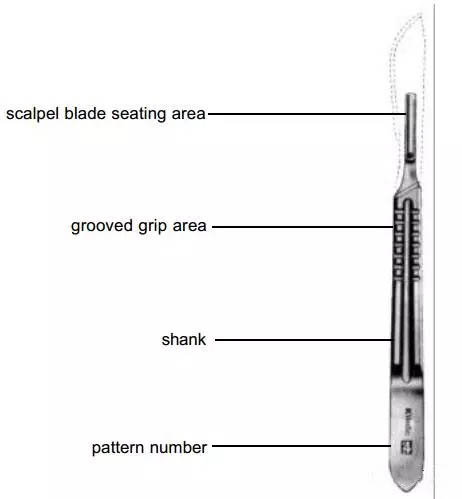
Figure 1 Scalpel
Of course there are sharp and round blades, sharp blades are mostly used in laparoscopic surgery, vascular surgery and cutting deep tissues, and round blades are mainly used to cut deep tissues such as peritoneum or to make sharp separations due to their inconspicuous tips.
2. High-frequency electrosurgical knife
With the advent of the high-frequency electrosurgical knife, the use of real scalpels has been greatly reduced.
The basic principle of high-frequency scalpel is actually the thermal effect of electricity, it is usually composed of an electric knife, host, negative plate and the patient constitutes a loop, due to the smaller the contact area, the greater the thermal effect produced, so the head of the electric knife and the body in contact with the body tends to produce a great thermal effect, intraoperative use of the electric knife hemostasis is the principle, and often the leader will be pointed tweezers or vascular tweezers to hold a small point of tissue so that we coagulate tweezers. Note that in the electrocoagulation and electrocautery will produce tissue gasification smoke, intraoperative attention should be paid to the suction device to suck the smoke.
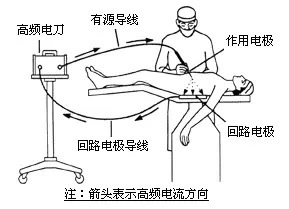
Figure 2 Schematic diagram of high-frequency electrosurgical knife
There are only two buttons on a basic pen, the yellow one for cut and the blue one for coag, but where to use them varies from person to person. In my opinion, coagulation is more advantageous when cutting through muscle, fascia and deeper tissues to control bleeding, while coagulation may be more advantageous when cutting through the dermis. Whether to use incision or coagulation for fat incision generally depends on the individual's habits!
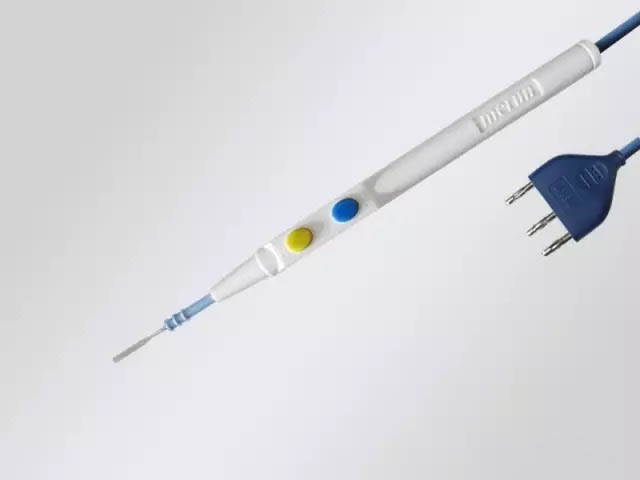
Figure 3 Monopole Electrode Pen
3. Bipolar electrosurgical knife
There are admittedly great advantages to the monopolar pen, but its disadvantages are also obvious, that is, its heat discharge is not precise enough, and it is easy to cause side damage to the tissue, especially in many areas close to the nerve alignment, monopolar electrocautery is often considered to be a contraindication, such as spinal surgery, brain surgery.
The bipolar knife is more precise than the monopolar knife, it does not need to use the negative plate, the circuit is formed between the bipolar, the discharge area is precise, and the side damage is much smaller compared to the monopolar. At the same time, bipolar scalpels are made by manufacturers in the shape of gun-like forceps, which is more conducive to hemostasis and tissue separation. When using bipolar for hemostasis and separation, it is important to keep the field relatively dry, which often requires the resident to use suction to help the operator visualize the field.
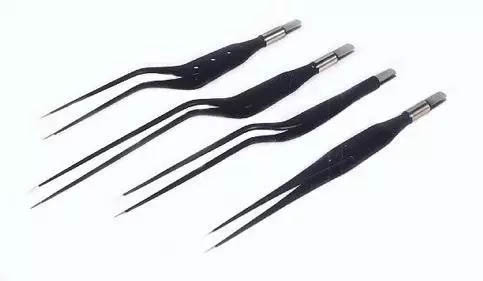
Figure 4 Bipolar electrosurgical knife
4. Ultrasonic knife
In recent years, there are many new hemostatic devices, such as ultrasonic knife, argon knife, Ligasure vascular closure system. In the author's opinion, the invention of ultrasonic knife has made many complex laparoscopic surgeries possible. For laparoscopic surgery, perhaps the right-handed ultrasonic knife and the left-handed bipolar separator forceps have become the standard equipment for the main knife.
Ultrasonic knife is through the ultrasonic frequency generator to make the metal knife head for mechanical shock, resulting in the flow of water in the tissue, vaporization, the tissue level is opened or free, the knife head and tissue protein contact, so that the protein denaturation coagulation, so that the blood vessel closure, the use of ultrasonic knife must be made to make the metal knife head away from the important tissue structure, to avoid injury.
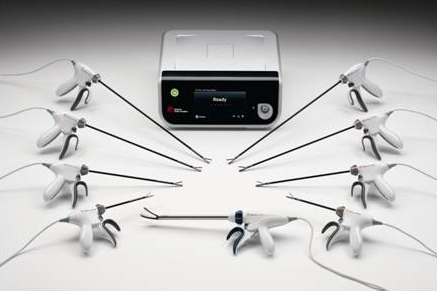
Figure 5 GEN11 Ultrasonic Knife
5. Argon knife
Argon knife is called “hemostatic artifact for extensive small bleeding”. Especially suitable for diaphragm and retroperitoneal blood seepage, its main principle is the use of argon beam generator in the high-frequency high-pressure effect of full ionization of argon into ions, the formation of an arc spray coagulation hemostasis.
6. Bipolar system
The Ligasure vascular closure system, also known as a computerized feedback-controlled bipolar system, combines high-frequency electrical energy with pressure between the blades to dissolve and denature the collagen and fibrin of the blood vessels to be cut, resulting in lumen closure.
The Ligasure can coagulate vessels up to 7mm in diameter, and its perivascular closure zone can withstand up to three times the body's systolic pressure, with a low local temperature and less tissue collateral damage during closure. However, the study found no significant difference in nerve damage between the Ligasure and ultrasonic scalpel in head and neck surgery.
Although the essence of the Ligasure knife is a kind of bipolar electrocoagulation, the voltage between the Ligasure bipolar blades is lower than that of the traditional bipolar knife, but due to its large contact area, it can allow a larger electric current to pass through, with a good coagulation effect, and at the same time, it can sense the signal of blood flow in the blood vessels, and cut off the tissues when coagulation and closure are completed.
However, the main disadvantage of Ligasure is that it takes longer to coagulate blood vessels, and if used for a long period of time, the ability to cut through tissues will be greatly diminished.
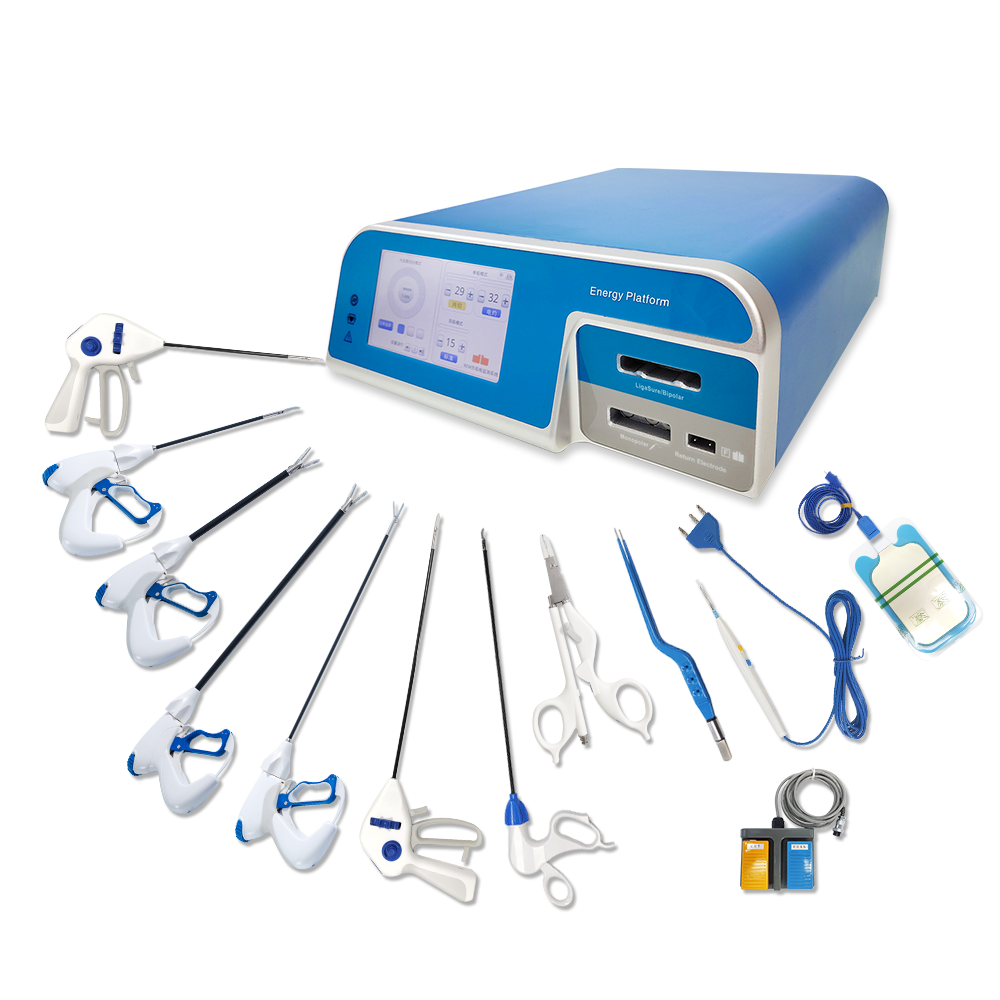
Figure 6 Ligasure vascular closure system
Clamp
1.Blocking forceps
First of all, let's talk about blocking forceps, especially the children who have finished the rotation of vascular surgery and cardiac surgery will certainly be impressed by all kinds of blocking forceps.
The main design principle of the blocking forceps is that its teeth are small, elastic and less damaging to the intima and walls of the blood vessels, and its shape is mainly designed according to the location of the target vessel to be blocked, and the common blocking forceps are vena cava blocking forceps, aortic blocking forceps, carotid blocking forceps, portal vein blocking forceps, etc. The main design principle of the blocking forceps is that its teeth are small, elastic and less damaging to the intima and walls of the blood vessels.
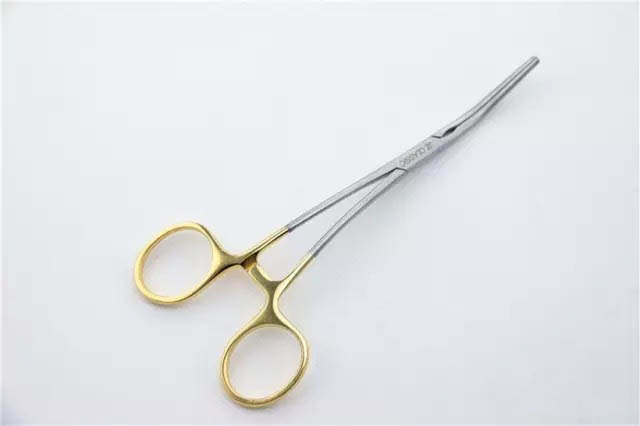
Figure 7 Blocking forceps
2. Hemostat
Then talk about the hemostatic forceps, according to the form can be divided into straight forceps, curved forceps, according to whether it is full teeth can be divided into full tooth forceps and half tooth forceps, of course, according to its size can be subdivided into different models, to do deep surgery can be used for long instruments, shallow surgery using short instruments.
Curved forceps are commonly used as vascular forceps because their tips are curved and not sharp enough to separate tissues and facilitate the next ligation operation, while straight forceps are often used for fixing instruments, traction and other purposes.
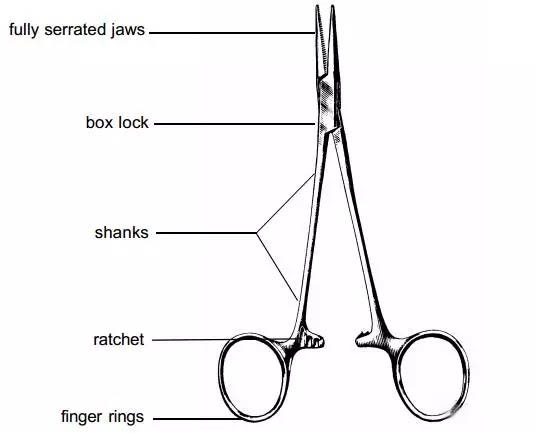
Figure 8 Hemostat
In addition, many people use left-handed curved forceps instead of forceps, and there are mixed feelings about this method of forceps instead of tweezers. The forceps can provide a better clamping force due to its longer arm than forceps, and it also has a separating function that forceps does not have, which has made many people accustomed to this method of forceps instead of tweezers. The opponents are mainly of the opinion that pliers are more traumatic to the tissues compared to forceps. The author believes that the so-called standardization of surgery is only the recognition of a behavior by most people, and this way of clamping instead of forceps is not a good way as long as you don't need to clip the skin with forceps.
However, if the surgical skills are not skilled enough, even if the use of forceps, repeated clamping lifting tissues will cause great tissue damage.
In the past, half-tooth forceps were often used as long forceps due to the unavailability of long forceps, and are now often used to bring in threads to assist in deep tissue ligation.
There are also many pliers with specialized uses, such as right-angle pliers, mosquito pliers, and Alis pliers. Right angle forceps are mainly used for separation of body cavity tissues, such as freeing and bypassing the posterior walls of major blood vessels, biliary tracts, and other tissues, and are widely used in thoracic and general surgery.
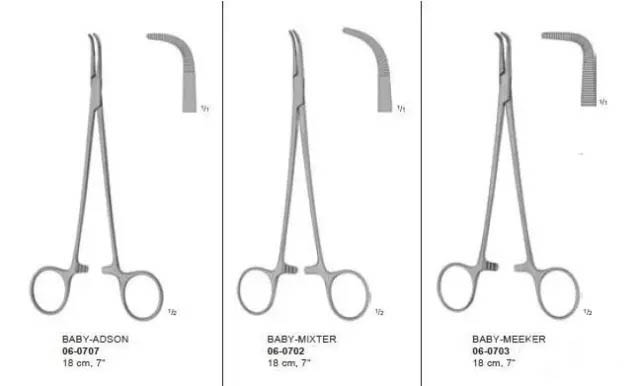
Figure 9 Right angle forceps with different curvatures
Mosquito forceps can be used for fine manipulation and suture fixation, however, a rubberized mosquito type is required for fixation of vascular sutures to avoid snagging the sharp threads.
Alis forceps, also known as rat-tooth forceps, are mainly used for retraction to help the operator visualize the surgical field, and Alis forceps are one of the few instruments that can be used to clamp the skin to help free subcutaneous tissue.
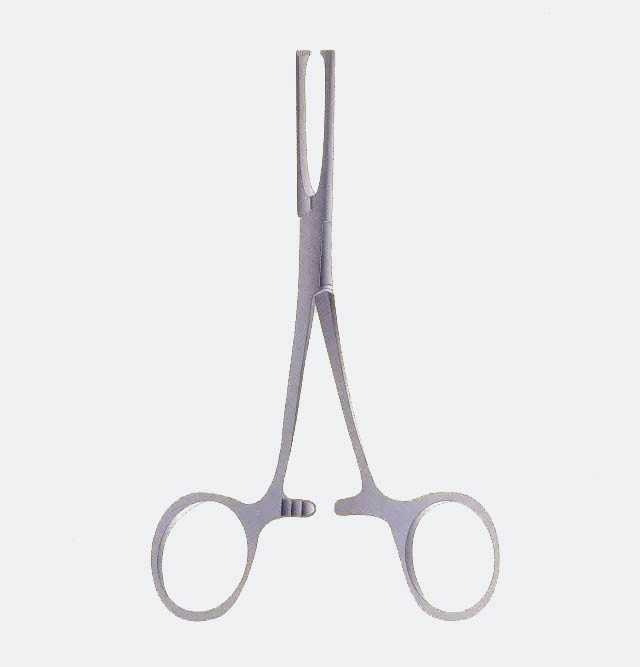
Figure 10 Alis forceps
 苏公网安备32011802010375号